


Last Updated on: 21st July 2026, 11:53 am
A good press release gives journalists the information they need to understand, verify and potentially report your announcement. It should explain what has happened, why it matters and who is involved without reading like an advertisement.
This guide explains how to write a press release from the headline through to the media contact details. It includes a standard press release format, practical examples, a copy-and-paste template and a checklist to complete before publication.
Once your announcement is written and approved, compare the best press release distribution services to determine which newswire offers the right media reach, targeting and pricing.
What is a press release?
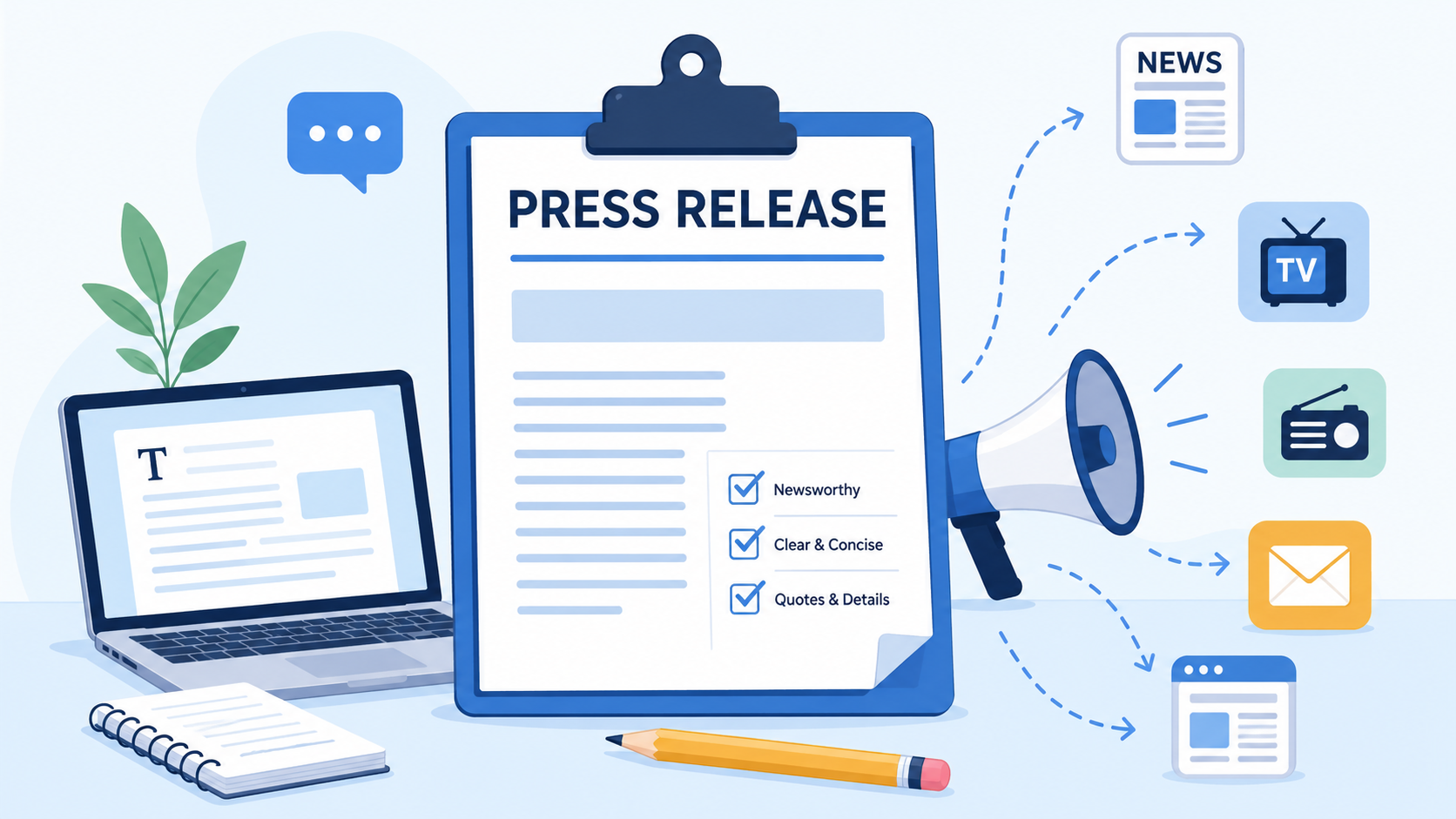
A press release is a written announcement supplied to journalists, editors, news desks and other media professionals. It communicates news about a company, charity, public body, individual, product, event or campaign.
It is sometimes called a media release, news release or PR announcement. Regardless of the name, its main purpose is to provide accurate, usable information that can help a journalist decide whether there is a story worth covering.
A press release is not the same as an advert. An advert speaks directly to potential customers and is designed to sell. A press release is written for the media and should focus on a newsworthy development.
What makes an announcement newsworthy?
- A story is more likely to attract attention when it contains one or more of the following:
- A new product, service, facility or business launch
- A substantial investment, funding round or acquisition
- New research, survey findings or industry data
- A senior appointment or leadership change
- A public event, campaign or charity initiative
- A response to a current issue or developing news story
- A significant contract, partnership or expansion
- An award with genuine relevance to the organisation or industry
- A story involving unusual people, places or circumstances
- A development that affects a particular region or community
The strongest releases usually contain a clear change. Something has launched, happened, increased, closed, opened, been discovered or been announced. Simply describing an existing business is rarely enough.
When should a company issue a press release?
A company should issue a press release when it has timely information that may be relevant to people beyond its existing customers and employees.
Before writing, complete this sentence:
This is news because…
The answer should be specific. “We want more exposure” explains your marketing objective, but it does not explain why a journalist or reader should care.
Stronger answers might include:
The business is opening the first facility of its kind in the region.
The research identifies a change affecting thousands of consumers.
The charity has reached a fundraising milestone following a national campaign.
The company has secured investment that will create 100 jobs.
The organisation is responding to a new law or industry development.
Avoid issuing releases for minor website changes, routine sales promotions, unsupported opinions or announcements that only matter internally.
The standard press release format
Journalists often review announcements quickly. A familiar structure makes it easier for them to identify the main facts and decide whether the story is relevant.
A standard press release normally contains the following elements:
- Release instruction: For immediate release or an embargo date and time.
- Headline: A concise description of the main announcement.
- Subheadline: Optional supporting detail that expands on the headline.
- Dateline: The location and date connected to the announcement.
- Opening paragraph: A summary covering the most important facts.
- Supporting paragraphs: Evidence, context, figures and further details.
- Quote: A useful comment from a named and relevant person.
- Call to action: Where readers can obtain more information or participate.
- Boilerplate: A short description of the organisation.
- Media contact: Contact details for journalist enquiries.
- Editor’s notes: Supporting information that does not belong in the main story.
Use the inverted pyramid
Press releases normally follow the inverted-pyramid structure used in news reporting. The most important information appears first, followed by supporting detail and then background information.
This allows an editor to shorten the release from the bottom without removing the central announcement.
How to write a press release headline
The headline should tell the reader what has happened. It does not need to explain every detail, but it should be specific enough for a journalist to understand the subject immediately.
A simple headline formula
Use:
Organisation + action + significant outcome
For example:
- Manchester manufacturer opens new facility creating 80 jobs
- UK charity launches campaign to improve access to rural healthcare
- Technology company secures £5 million to expand European operations
- New study finds one in three small firms plan to increase hiring
Weak headline
Innovative company announces exciting new solution
Improved headline
Bristol software company launches booking platform for independent hotels
The improved version identifies the organisation, location, action, product and intended market.
Headline writing tips
Lead with the announcement rather than the company slogan.
Use an active verb such as launches, appoints, opens, acquires or publishes.
Include a useful number when it adds scale or context.
Mention the location when the story has regional relevance.
Avoid all-capital headlines and unnecessary exclamation marks.
Remove claims such as revolutionary, world-leading or unique unless they can be proved.
Write the headline after completing the release if the main angle is not yet clear.
Look at the headlines used by the publications you want to reach. This helps you understand how those outlets describe similar stories and which details they place first.
How to write the opening paragraph
The opening paragraph, sometimes called the lead or introduction, should summarise the announcement in one or two sentences.
It should usually answer:
- Who? Which organisation or person is involved?
- What? What has happened or been announced?
- When? When did it happen or when will it happen?
- Where? Where is the development taking place?
- Why? Why does it matter?
- How? How will it work or what made it possible?
Not every answer needs to be squeezed into one sentence. Concentrate on the details a journalist needs to understand the story.
Example opening paragraph
A Leeds-based renewable energy company has secured £8 million in funding to build 20 community solar projects across northern England, with the first sites expected to begin operating next year.
This tells the reader who is involved, what has happened, the value of the investment, the intended result, the location and the approximate timetable.
Avoid slow introductions
Do not begin with several sentences about general industry trends before revealing the announcement.
Instead of:
The business environment is changing rapidly, and companies across every industry are searching for better ways to operate.
Write:
A Birmingham logistics company has introduced a same-day delivery service for independent retailers across the West Midlands.
What information do journalists expect?
After the opening paragraph, provide the details needed to assess and verify the announcement. Every paragraph should answer a likely question.
Facts and evidence
Include relevant figures, dates, locations and supporting evidence. Specific information is more useful than general claims.
For example:
The amount invested or raised
The number of jobs being created
The date a service becomes available
The number of people surveyed
The geographical area affected
The names of organisations participating
The source and methodology behind research
Context
Explain what has changed and how the announcement fits into the wider situation. A funding announcement, for example, should explain how the money will be used rather than only stating that it has been raised.
Attribution
Identify the source of statistics and claims. Do not present third-party research as though it was produced by your organisation.
Supporting materials
- Prepare materials that may help a journalist develop the story, including:
- High-resolution photographs
- Accurate image captions
- Names of everyone pictured
- Research reports or data tables
- Product information
- Executive biographies
- Interview availability
- Video or audio footage
Do not attach large files without warning. Provide clearly labelled download links or a media folder where appropriate.
How to use quotes properly
A quote should add interpretation, reaction or human perspective. It should not simply repeat the factual information already contained in the opening paragraph.
Weak quote
“We are delighted to announce the launch of our new platform,” said Jane Smith, managing director.
Improved quote
“Independent hotels often rely on several disconnected systems to manage bookings. We built the platform to give smaller operators one place to control availability, payments and guest communication,” said Jane Smith, managing director.
The second quote explains the problem being addressed and why the development matters.
Quote checklist
Use a named spokesperson with a relevant role.
Explain why the announcement matters.
Add opinion or insight rather than repeating facts.
Keep the language natural enough to be spoken aloud.
Avoid corporate slogans and lengthy job titles.
Confirm that the quoted person has approved the wording.
One strong quote is usually more useful than several comments that communicate the same message.
Boilerplate and media contact details
What is a press release boilerplate?
The boilerplate is a short description of the organisation issuing the release. It normally appears near the end and can be reused across multiple announcements.
It may include:
What the organisation does
When and where it was established
The customers or communities it serves
Its principal products or services
A link to its website
Example boilerplate
Northfield Energy develops and operates community renewable-energy projects across the UK. Established in Leeds in 2018, the company works with local authorities, landowners and community organisations to develop solar and battery-storage facilities.
Keep the boilerplate factual. Avoid turning it into a long sales pitch or listing every service the organisation has ever offered.
Media contact information
Include a contact who can answer questions promptly. Provide:
Full name
Job title or relationship to the organisation
Email address
Telephone number, including country code where appropriate
Website
Availability for interviews
Check that the named contact will be available after distribution. Media opportunities can be lost when enquiries go unanswered.
Press release examples
The structure remains broadly consistent, but the information emphasised will depend on the type of announcement.
Product launch press release example
Headline:
British skincare company launches refillable packaging across full product range
Opening:
London-based skincare company Alder & Moss will introduce refillable packaging across its complete product range from September, replacing an estimated 120,000 single-use containers each year.
The following paragraphs should explain how the system works, where it will be available, what evidence supports the waste-reduction estimate and how the change affects customers.
New appointment press release example
Headline:
Regional housing charity appoints Sarah Patel as chief executive
Opening:
North West housing charity HomeBridge has appointed Sarah Patel as chief executive, succeeding Mark Ellis when he retires at the end of October.
Include the appointee’s relevant experience, the organisation’s immediate priorities, the start date and comments from both the appointee and the chair where available.
Research press release example
Headline:
One in four UK freelancers delayed major purchases last year, survey finds
Opening:
One in four UK freelancers postponed a major household purchase during the past year because of unpredictable income, according to a survey of 2,000 self-employed workers commissioned by Finwork.
Research releases should include the sample size, fieldwork dates, methodology, polling company and access to the complete findings.
Charity campaign press release example
Headline:
National campaign seeks 5,000 volunteers to support isolated older people
Opening:
Community charity Together UK has launched a national recruitment campaign seeking 5,000 volunteers to provide weekly telephone calls and local visits to older people experiencing isolation.
Explain the scale of the problem, the areas covered, what volunteers will do and how people can register.
See more real press release examples covering product launches, events, charities, appointments, acquisitions and other announcement types.
Copy-and-paste press release template
Use the following template as a starting point. Remove any instructions in square brackets before submitting the release.
FOR IMMEDIATE RELEASE
[Clear headline explaining the announcement] [Optional subheadline providing one additional detail] [CITY, DATE] — [Organisation name] has [announced/launched/opened/published/appointed] [main announcement], [brief explanation of why it matters]. [Provide the most important supporting information. Include useful figures, dates, locations, participating organisations or details about how the announcement will work.] [Add further context. Explain the problem being addressed, what has changed or why the development is relevant now.]“[Add a quote that provides reaction, interpretation or insight rather than repeating the opening paragraph],” said [full name], [job title] at [organisation].
[Include any additional evidence, timetable, availability, eligibility criteria or instructions for people affected by the announcement.]For more information, visit [relevant webpage].
ENDS
About [organisation] [Provide a short, factual description of the organisation, including what it does, who it serves and where it operates.]
Media contact
[Full name] [Job title] [Email address] [Telephone number] [Website]Notes to editors
[Research methodology or supporting source] [Photograph and interview availability] [Relevant background information]Pre-publication press release checklist
Complete these checks before sending your announcement to the media.
News and accuracy
Is there a clear and timely announcement?
Can you explain why the story matters in one sentence?
Are all names, figures, dates and job titles accurate?
Can every major claim be supported?
Have quoted individuals approved their comments?
Have legal, regulatory or confidentiality concerns been checked?
Headline and opening
Does the headline clearly describe what happened?
Is the main announcement included in the opening paragraph?
Does the introduction answer the most important who, what, when, where and why questions?
Have you removed vague promotional language?
Structure and readability
Is the most important information placed first?
Are paragraphs short and easy to scan?
Have technical terms and acronyms been explained?
Does each paragraph add new information?
Can unnecessary background information be removed?
Media materials
Are high-resolution images available?
Do the image captions identify everyone pictured?
Do you have permission to distribute the photographs?
Are supporting reports, data and videos accessible?
Are interview spokespeople available?
Contact and distribution
Are the media contact details correct?
Will someone monitor enquiries after publication?
Have you selected the correct industry and geographical targets?
Have you checked for major competing news or events?
Is the release date or embargo instruction clear?
Read the finished release aloud and ask someone unfamiliar with the announcement to review it. A second reader will often identify missing context, unexplained terms or sentences that are too long.
How to distribute a press release
Writing the release is only the first stage. It must then reach journalists, editors and publications that cover the subject of the announcement.
The main distribution methods are:
- Contact relevant journalists directly
Build a focused list of journalists who regularly cover your industry, location or type of announcement. Read their recent work before approaching them.
Send a concise email explaining why the story is relevant to their readers. Avoid sending the same generic pitch to unrelated contacts.
- Publish the release in your online newsroom
Add the announcement to a permanent newsroom or media section on your website. Include photographs, company information, previous announcements and media contact details.
- Share the announcement through owned channels
Publish supporting content through company newsletters, social media accounts, stakeholder communications and relevant professional communities.
Adapt the wording for each channel instead of pasting the complete press release everywhere.
- Use a press release distribution company
A distribution provider can publish the release and deliver it through established media, subscriber, syndication or newswire channels.
This can be useful when you do not have an established media database, need broader geographical reach or want access to specialist distribution channels.
Compare newswire services according to relevance and distribution quality rather than relying only on the largest headline reach figure.
Choosing a newswire or distribution service
Press release distribution companies vary significantly in their pricing, geographical coverage, editorial process and media networks.
Before choosing a provider, consider:
Geographical reach: Does it cover the UK, a particular region or international markets?
Industry targeting: Can the release be sent to journalists covering the relevant subject?
Editorial review: Will someone check the release before publication?
Syndication: Which news platforms, databases or partner sites receive the content?
Journalist access: Does the service reach active media subscribers or news desks?
Multimedia support: Can you include photographs, documents or video?
Reporting: What publication, referral or coverage information is provided?
Pricing: Are there additional charges for word count, images, targeting or international delivery?
Contracts: Can you submit one release, or is a subscription required?
Support: Can you contact an editorial or account team when assistance is needed?
A large distribution list is not automatically the most appropriate one. A release about a new restaurant in Manchester may benefit more from focused regional and hospitality targeting than from a broad international list.
Pressat has provided press release distribution since 2010. Its editorial team reviews submissions and targets relevant journalists, editors, news desks and media channels according to the subject and geographical relevance of each announcement.
Frequently asked questions
How long should a press release be?
A press release should be long enough to communicate the announcement and support it with evidence, but short enough to review quickly. Many straightforward releases can be covered in approximately 400 to 600 words. Complex financial, legal or research announcements may require more detail.
Do not add words simply to reach a target length. Remove repeated statements, unnecessary company history and generic market commentary.
Should a press release be written in the first or third person?
The main body is generally written in the third person, using the organisation’s name rather than “we” or “our”. First-person language is appropriate inside attributed quotations.
Should I include keywords in a press release?
Use the names and phrases people naturally associate with the announcement, but do not force keywords into every paragraph. Clarity and factual accuracy should come first.
The headline and opening paragraph should describe the actual news. Avoid inserting unrelated search terms solely in an attempt to attract website traffic.
Should I attach the press release as a PDF?
Include the essential information in the email or publishing platform rather than requiring a journalist to open a PDF. A PDF can be supplied as an additional version when useful, but it should not be the only accessible copy.
Should a press release include images?
Relevant photographs can help journalists assess and illustrate a story. Supply high-resolution files with accurate captions, photographer credits and confirmation that you have the right to distribute them.
How many links should be included?
Include links that help the reader verify the announcement or take the next step. This may include a product page, research report, event registration page or the organisation’s website.
Avoid filling the release with repeated links or using unnatural anchor text.
What does “for immediate release” mean?
“For immediate release” tells recipients that the information can be published as soon as it is received. When information must not appear before a particular date and time, provide a clear embargo instruction instead.
What is an embargoed press release?
An embargoed release is supplied to selected journalists before publication on the understanding that the information will not be reported until the stated date and time.
An embargo gives journalists time to conduct interviews, review research or prepare coverage. Confirm that recipients have agreed to respect it rather than assuming every contact will do so automatically.
When is the best time to send a press release?
The best timing depends on the publication, industry and nature of the story. Consider journalists’ deadlines, major scheduled events, public holidays and competing news.
Event announcements should be sent early enough for publications to plan coverage. Breaking or reactive statements may need to be distributed immediately.
Can a small business write its own press release?
Yes. A small business can write its own release when it has a genuine announcement and can explain it clearly. The most important requirements are accuracy, a strong news angle, a recognisable structure and responsive media contact details.
Does distributing a press release guarantee media coverage?
No legitimate distribution service can guarantee that independent journalists will report a story. Distribution places the announcement in front of relevant recipients and channels, but editorial coverage depends on the strength of the story and the publication’s own decisions. Using a press release distribution service can be a useful option for obtaining syndication to 3rd party websites.
Writing a media-ready press release
An effective press release is built around a clear piece of news. State the announcement in the headline and opening paragraph, support it with evidence, add a useful quote and make it easy for journalists to obtain further information.
Before distributing the release, check every fact, remove promotional language and confirm that your media contact is available. Then choose distribution channels based on the subject, location and audience most likely to care about the story.